Boat Attacks & Salmon Hats: Two Orca Whale Behaviors Considered Mysteries. Here’s An Acoustic Explanation & Supporting Data

Orcas attacking sailboats are due to the noise pollution of the boats.
Caveat: I am not a marine biologist and have no qualification, authority, or credibility on this topic.  This is a hypothesis for contemplation / discussion. 

The Noise Imperative: Why Orcas Are Sinking Sailboats

Tl;dr: The Core Argument

The attacks are a survival-based behavior to protect food source driven by acoustics (“Trophic Defense Mechanism”). The Strait of Gibraltar is an acoustic funnel that traps and amplifies noise. Sailboats generate Structural Borne Noise (SBN), a high intensity acoustic jam that disrupts orca communication and hunting. Orcas destroy the rudder to eliminate this noise source and secure their food supply.  Attack frequency has a strong correlation to tuna prevalence.

History of The Orca Mysteries

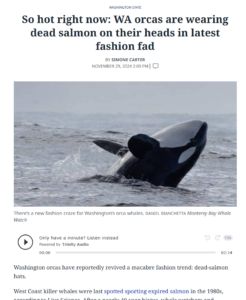
Orca whales with 'salmon hats' on their heads construed as a fashion fadFirst, it was the ‘salmon hats’. Orcas in the Pacific Northwest (known as Southern Resident Killer Whales) were seen with dead salmon on their heads.  Scientists speculated it a “fashion fad”, and the media ran with it.

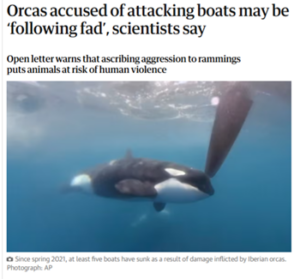
Next, the Iberian Orcas began attacking sailboats in May 2020 off the Iberian Coast / in the Straight of Gibraltar (near Spain and Portugal). Scientist speculated the attacks were also a ‘fad’. More than 500 boats have been attacked to date.

I’m not a marine biologist (my education was molecular biology). I began researching the boat attacks and salmon hats because I was surprised by the “fad / trend” and “fashion / just playing” explanations given. More often than not, there’s a Darwinian explanation, especially when the subject species is critically endangered.
orcas attacking boats a fad | Craig Hordlow


Salmon Hats: Fashion Trend or Noise-Filtering “Earplugs”?

The mainstream hypothesis for the salmon hats is that it’s just a ‘fashion trend’ (or ‘fad’), an anthropomorphic explanation with literally zero functional utility.

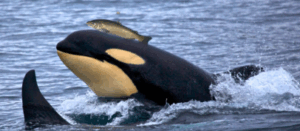
the “salmon hats” were positioned directly about the melon (echolocation)
Orca wearing a 'salmon hat'
Orca wearing a ‘salmon hat’

There’s no data I could find to analyze this behavior, so I assembled a factual basis into a sequence of logic statements to see where it would lead.

Salmon tissue absorbs and scatters sound, especially low-frequency noise.
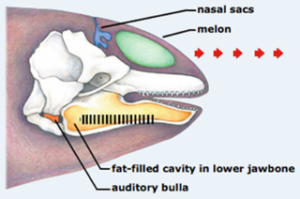
By placing the fish over their melon (the organ responsible for echolocation), an orca may be experimenting with a natural noise filter.
If ship noise is interfering with their echolocation, a salmon hat could act as a dampening shield, helping them focus their sonar signals.
Orcan melon, echolocation
the “salmon hats” were positioned directly about the melon (echolocation)

This behavior might not be widespread because only certain pods are experimenting with this sensory modification technique.
Local Dolphins Attack Fishing Gear to Increase Food Supply

Dolphins and orcas are both cetaceans.

Dolphins in the Mediterranean Sea are reported to frequently interact with, and damage, fishing equipment in order to obtain food  (Bearzi 2002, Gonzalvo and Carpentieri 2023, Li Veli et al. 2023).

This behavior demonstrates that cetaceans will deliberately damage human constructs as trophic defense mechanisms.

Why Orca Whales Attack Sailboats and Not Motorboats

1.  The Sailboat (Maximum SBN Radiator)

Light fiberglass sailboats act like unshielded antennas. Their engines pump out Structural-Borne Noise (0.25–20 kHz), the exact band that overlaps and cripples the orcas’ pulsed communication calls. 

  • Construction: Typically lightweight fiberglass/composite.
  • Acoustic Problem: Fiberglass is terrible at dampening vibration. The hull is thin, designed for speed and light weight, not structural rigidity or sound insulation.
  • The Problem: The engine’s vibration travels easily through the thin hull and straight to the unsupported spade rudder, which acts like a massive speaker cone radiating the disruptive SBN into the water. The boat is transformed into a high-intensity acoustic weapon.

2. The Motorboat (Low SBN Radiator)

  • Construction: Often features a heavier, stiffer hull (more layers of fiberglass, or sometimes steel/aluminum) and a different engine configuration.
  • Acoustic Virtue: Heavier, denser materials and stronger internal supports dampen and absorb the engine’s vibration before it reaches the rudder. The vessel is far more effective at isolating the engine noise.
  • The Result: Motorboats are often acoustically quieter in the critical frequency range. While they create noise, they don’t efficiently radiate the specific, continuous, high-intensity SBN spike that jams the orcas’ pulsed calls.

Factual Basis…

  1. The Straight of Gibraltar / Iberian Coast is the epicenter of orca attacks
  2. The Iberian Orcas’ diet is mainly Atlantic Bluefin Tuna, and the orca’s migration patterns are synchronized with the tuna’s through the Strait of Gibraltar / Iberian coast  
  3. Orca Attack frequency correlates with relative number of tuna present
  4. The orca’s acoustic frequency range (for hunting) is ~0.5 to 100 kHz, with the most vital pulsed calls and whistles being ~1 to 20 kHz
  5. High-frequency vibration and cavitation noise from sailboats (mostly from engine) directly overlaps with the orca’s range, though even with the engine off there is critical overlap 
  6. Orcas target rudders of boats in these regions
  7. It is significantly more difficult for orcas to catch tuna in deep water than in shallow water 
  8. The Straight is a shallow body with a topology that amplifies and traps underwater acoustics
  9. The Strait is a critical chokepoint and a key fishing ground for Atlantic Bluefin Tuna as they travel to and from their Mediterranean spawning grounds.
  10. The Iberian Orca is critically endangered, the most cited causal factor is the collapse of the Atlantic Bluefin Tuna population due to decades of overfishing

Orca Boat Attack Triggers: Iberian Coast vs the Straight

The orca attacks are distributed across two primary zones: the Strait of Gibraltar and the shallower Iberian Coast (Galicia and Portugal). This pattern might be explained by the difference in acoustic properties and hunting efficiency between the two areas.

The Strait of Gibraltar: Maximum Acoustic Stress

The Strait acts as the source of chronic acoustic frustration for the orcas, creating the initial motive for aggression:

Acoustic Amplification:

The Strait’s bathymetry (seafloor) and narrow land funneling create an Acoustic Waveguide effect. This traps and reflects sound, resulting in a significantly amplified, chronic background noise level.

Chronic Din:

This acoustic geometry, combined with relentless global shipping, generates the region’s highest measured Sound Pressure Levels (SPLs) in the low-frequency range (), which induces high physiological stress on the orcas, as cited by the AMIGOS survey.

  • Attack Concentration: The Strait accounts for a smaller portion of the overall attacks (), suggesting it provides the chronic stress but a lower incentive for the learned behavior to take hold.

The Iberian Coast: Maximum Trophic Reward

The majority of attacks () occur along the Iberian Coast because this zone provides the greatest acoustic payoff for the orcas’ behavior, allowing them to maximize the chances of a successful kill:

  • Hunting Value: This area is the major feeding ground for the orcas, full of Bluefin Tuna. Crucially, the continental shelf’s shallow water ( average depth) gives the orcas a major physical advantage over the tuna, which cannot deep-dive to escape, making the hunt highly valuable.

  • Effective Silence: While traffic noise is still present, the shallower depth creates a smaller volume of water. When the orcas successfully immobilize a rudder and the noise source stops, the resulting acoustic silence is more complete, immediate, and effective, creating a stronger acoustic reward that powerfully reinforces the learned behavior.

Acoustic Emissions Directly Overlap Critical Orca Frequency Ranges

Overlapping acoustic frequency emissions mask and interfere with the vocalizations and echo-location critical to orca hunting (and other activites). 

While sailboats are generally quiet, they produce two types of noise that are highly relevant to the attacks:

  1.  Rudder/Propulsion Vibration Noise: This is the most likely trigger. When a sailboat is under engine or moving at high speed, turbulence around the rudder and propeller, and especially any mechanical wear, generates broadband noise that includes frequencies from 250 Hz up to 20 kHz or more.
    Overlap: This range is close to or even overlaps with the low-end of orca echolocation clicks (which start around 25 kHz). The noise doesn’t have to be identical to interfere; it just needs to be loud enough to mask the returning echoes the orca needs to pinpoint the tuna.
  2. Cavitation Noise: This is the high-frequency sound of bubbles collapsing, often generated by a propeller spinning fast. It can produce noise in the 10 kHz to 50 kHz range.
    Overlap: This range is close to or even overlaps with the low-end of orca echolocation clicks (which start around 25 kHz). The noise doesn’t have to be identical to interfere; it just needs to be loud enough to mask the returning echoes the orca needs to pinpoint the tuna.

See Sources & Citations at bottom of page

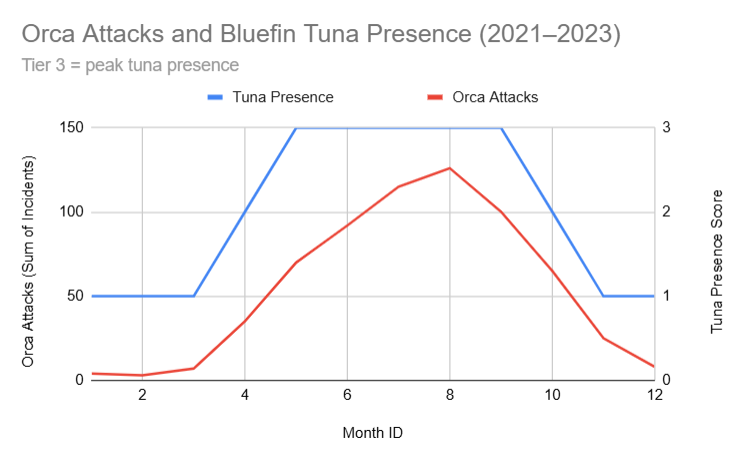
Correlation of Orca Attacks with Tuna Presence

Table 2: Orca Attack Frequency & Tuna Presence

I looked at the frequency of orca attacks for each of the 12 months of the year, over three years (2021-23) and the presence of tuna for that month. 

I couldn’t find tuna count data (apparently no one is counting the exact number in any given location at all times) so I used the relative numbers based on migration patterns (as a proxy).  

chart showing frequency of orca boat attacks to number of tuna present

Strong Correlation of Attack Frequency to Tuna Presence

Iberian Orca attacks have a Pearson Correlation to the abundance of tuna of +0.94 (very strong positive correlation). Tuna Presence Score (Relative Index, 1–3): This scoring system is a methodological construction for quantitative analysis. The score is derived from the established annual migration cycle of the Atlantic Bluefin Tuna through the Strait of Gibraltar and along the Iberian Coast, as documented by the International Commission for the Conservation of Atlantic Tunas (ICCAT) and corroborated by local cetacean research groups (e.g., GTOA, Alnilam). The tiers reflect the biological criticality of the hunting season and the corresponding presence of the species. Data Source: Orca Attack Incidents aggregated monthly from Grupo de Trabajo Orca Atlántica (GTOA) Annual Reports (2021, 2022, 2023). Bluefin Tuna Presence Score derived from general scientific consensus on seasonal migration patterns.

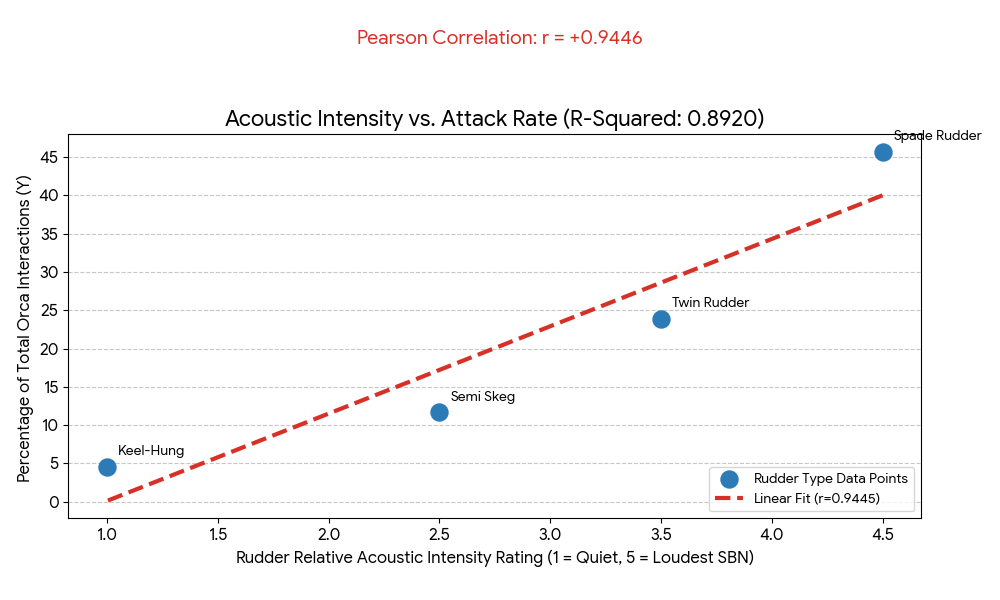
"Noisiest" Rudders Attacked the Most, But Data Not Normalized for Prevalence

While it appears the ‘noisiest’ rudders have a strong correlation with attack percentages, don’t read too much into this.  The source data was not normalized for prevalence.  For example, the spade rudder is both the most attacked and most common type.
orca whales, orca boat attacks, rudder sound intensity
Correlation of sailboat rudder acoustic intensity to percentage of orca whale attacks

Source: Grupo de Trabajo Orca Atlántica (GTOA) Interaction Survey

Potential Preventitive Measures

If this hypothesis is correct, mitigation is about reducing sound emissions.

Table 2: Potential Preventitive Measures

Just a brainstorm. I'm not the guy to figure this part out...
MeasureGoalNotes
Rudder DampeningStop the rudder from becoming a high-frequency noise radiator.Install elastomeric or rubberized coatings or dampeners on the leading and trailing edges of the rudder blade to absorb structural vibration.
Propeller Isolation MountsDecouple engine noise from the hull structure.Use highly resilient, specialized engine and propeller shaft mounts to prevent the transfer of low-to-mid-frequency vibration into the hull.
Routine Propeller MaintenanceReduce turbulence and imbalance.Polish propellers frequently to remove fouling and ensure perfect balance. Even minor chips or fouling increase turbulence, which radiates noise.
Use Low-Vibration MaterialsDesign the vessel to be acoustically neutral.For new builds, use materials that inherently dampen vibration in high-stress areas near the steering mechanism.

Defending Orca Attacks in Progress

Think Twice About Firecrackers & Other Loud Things During an Orca Attack

Sailors have been trying to scare off the whales with firecrackers, going in reverse, and other tactics that increase the noise levels. The data suggests that once an attack starts, whether you turn your engine off or not doesn’t make a significant difference.

What I Would Do: Cut the Engine & Play Recordings of Non-Local Orcas or Long-Fin Pilot Whales

If my hypothesis is correct, then the best response could be cutting the engine and distracting the orcas by playing hunting calls of non-local orcas or long-fin pilot whales (download mp3’s below). 

Since we know the attacks have a correlation to tuna presence and presumably hunting, playing hunting vocalizations of non-local orcas or long-fin pilot whales would trigger a strong response in a natural setting.  The objective is to turn their attention to a larger threat that requires immediate investigation and possibly even retreat.  Pilot whales are known to gang up on orcas in this region and chase them out of feeding areas.

How This Could Go Wrong

  • Orcas are smart enough that they’d eventually figure out that the whale calls are not real and they’d ignore them, or possibly worse – target the boat for further polluting their soundscape in an attempt to manipulate them.
  • The orcas don’t realize the sounds are artificial but do realize the boat is the source and direct defensive / attack behavior on the boat.

Downloadable Orca & Long-Fin Pilot Whale Recordings

Below are some links to audio tracks of orcas and long-fin pilot whales. They’re not very long and they are not produced for the purpose of defending against an attack, so give serious thought to how you’d use it.  If you’re reading this and you have the qualifications to provide insight on this idea, please share.

Table 3

Sources / Citations

Data Source: Acoustic Interference Analysis (Synthesis of Bioacoustic Data). Frequency ranges and functional impacts derived from:

  1. Chronic Din: Perez Tadeo M and O’Brien J (2025). Underwater noise levels in the Strait of Gibraltar… (The AMIGOS Survey).

  2. Orca Communication/Pulsed Calls: General marine mammal bioacoustics literature and proxy data on related cetaceans (e.g., Poupard et al. on pilot whale acoustics).

  3. Orca Echolocation: General killer whale acoustic biology (standard to range).

  4. Sailboat Emissions: Engineering and acoustic studies on propeller/rudder cavitation noise (broadband noise and vibration).

Links

Craig Hordlow: Mutation Accumulation in Nuclear, Organelle, and Prokaryotic Transfer RNA Genes 


Data Source: Acoustic Interference Analysis (Synthesis of Bioacoustic Data). Frequency ranges and functional impacts derived from:

  1. Chronic Din: Perez Tadeo M and O’Brien J (2025). Underwater noise levels in the Strait of Gibraltar… (The AMIGOS Survey).

  2. Orca Communication/Pulsed Calls: General marine mammal bioacoustics literature and proxy data on related cetaceans (e.g., Poupard et al. on pilot whale acoustics).

  3. Orca Echolocation: General killer whale acoustic biology (standard to range).

  4. Sailboat Emissions: Engineering and acoustic studies on propeller/rudder cavitation noise (broadband noise and vibration).

Use the short URL for this page: https://craighordlow.com/go/f89d